August 30, 2010

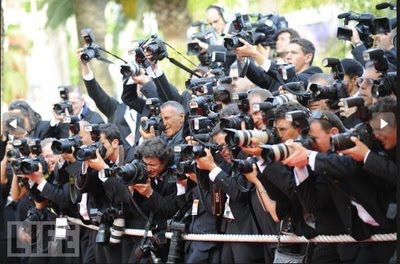
Toronto Film Fest enacts rules for paparazzi

Reservations will be required for red carpet access


That's the new red carpet rule for paparazzi at the Toronto International Film Festival, where media outlets this September will be required to RSVP before being assigned nightly vantage points to snap the stars.

Jettisoning the old lottery system and red carpet jostling, Toronto will see celebrity camera crews and photographers each morning reserve by email the films they want to cover that afternoon and evening.

Paparazzi will then receive an email confirming whether or not they were granted a spot at their desired red carpet.

TIFF organizers are determined to make their new rules for snappers stick.

"Red carpet assignments will be made for each and every carpet -- media outlets will not retain the same spot on every carpet, on every night or at every venue," the festival said in its new red carpet protocol released on the weekend.

Organizers will not take reservations by phone, only email, and insist they will assign spots on the red carpet according to a film's audience, reach and geography, among other criteria.

Establishing etiquette among paparazzo in Toronto comes as fest organizers have extended red carpets outside a host of festival venues, and charged cinema-goers extra for the privilege of seeing their favorite stars strut into theaters.

July 28, 2010

Photog Killed as Wedding Couple Poses With Guns

One of them turned out to be loaded!

A wedding photographer in Italy who convinced the couple to pose with guns got shot to death when one went off. The bride's parents, who provided the weapons, face charges of negligence for not making sure they were unloaded, reports the Daily Mirror. The 45-year-old victim was filling in for the regular photographer.


"From what we have been able to establish, the photographer had asked the parents of the bride and groom if they had any guns to use as props in a picture and one went off hitting him in the head killing him," said a police spokesman.


Read the rest of the story HERE.

July 26, 2010

Freedom of photography: Police, security often clamp down despite public right

By Annys Shin
Washington Post Staff Writer


A few weeks ago, on his way to work, Matt Urick stopped to snap a few pictures of the U.S. Department of Housing and Urban Development's headquarters. He thought the building was ugly but might make for an interesting photo. The uniformed officer who ran up to him didn't agree. He told Urick he was not allowed to photograph federal buildings.

Urick wanted to tell the guard that there are pictures of the building on HUD's Web site, that every angle of the building is visible in street views on Google Maps and that he was merely an amateur photographer, not a threat. But Urick kept all this to himself.
"A lot of these guys have guns and are enforcing laws they obviously don't understand, and they are not to be reasoned with," he said. After detaining Urick for a few minutes and conferring with a colleague on a radio, the officer let him go.

Courts have long ruled that the First Amendment protects the right of citizens to take photographs in public places. Even after the terrorist attacks of Sept. 11, 2001, law enforcement agencies have reiterated that right in official policies.

But in practice, those rules don't always filter down to police officers and security guards who continue to restrict photographers, often citing authority they don't have. Almost nine years after the terrorist attacks, which ratcheted up security at government properties and transportation hubs, anyone photographing federal buildings, bridges, trains or airports runs the risk of being seen as a potential terrorist.

Reliable statistics on detentions and arrests of photographers are hard to come by, but photographers, their advocates and even police agree that confrontations still occur frequently. Photographers had run-ins with police before the 2001 attacks, but constitutional lawyers say the combination of heightened security concerns and the spread of digital cameras has made such incidents more common.

In the past month, in addition to Urick's encounter, a retired oceanographer said he was threatened with arrest for snapping pictures of a federal courthouse in Silver Spring, and an Alexandria man was briefly detained for photographing police making a traffic stop in Georgetown.
(Traffic stop video sparks debate over police use of wiretap laws)
Law enforcement officials have a hard time explaining the gap between policy and practice. The disconnect, legal experts say, may stem from a dearth of guidelines about how to balance security concerns with civil liberties.
"Security guards are often given few rules to follow, but they have clearly gotten the message that they need to be extra vigilant," said Kent Willis, executive director of the American Civil Liberties Union of Virginia. "In the end, it seems you never know how a particular security guard is going to react."

Clarifying the law
Last year, New York City police sought to clarify the rules on photography with a directive to all officers. It said that photography is "rarely unlawful" and that officers have no right to demand to see photos or to delete them. Like Washington, New York is a potential terrorist target but also a major tourist destination, and as a result, the directive said, "practically all such photography will have no connection to terrorism or unlawful conduct."

Police officials say officers who seek to stop photography are driven by safety concerns and the fact that the presence of a camera can spike emotions.

"When people see a camera, they get more into it," said Marcello Muzzatti, president of D.C. Lodge No. 1 of the Fraternal Order of Police, which represents 11,000 officers in more than 100 D.C. and federal agencies. "Some people will figure, 'I have a right to take pictures,' and we are not arguing with that. An officer also has a right to his or her safety and to control the situation."

The flip side of that coin is that "photography creates a relatively objective record," said Catherine Crump, a lawyer with the ACLU's national office. "The police certainly realize this, which is why they routinely record their interaction with citizens. And there is no reason why people should be deprived of that same tool."

Photographers are challenging unwarranted restrictions by collecting hundreds of photos that prompted police questioning, detention or arrest; the pictures are posted on online photo sharing sites such as Flickr.

Local photographers are also testing trouble spots, especially outside federal buildings, many of which are guarded by the Federal Protective Service, an agency in the Department of Homeland Security that has 1,225 officers and 15,000 contract guards to secure more than 9,000 buildings nationwide.

Erin McCann of the District elicited laughter at a congressional hearing last fall when she described an encounter with an FPS officer at the Transportation Department headquarters in Southeast. The officer told her it was illegal to photograph federal buildings. When McCann asked what law stated that, the officer cited Title 18 of the U.S. Code. Title 18 is the name of the entire body of U.S. criminal law.

Official FPS guidance, issued in 2004, reads: "Please understand there is no prohibition against photographing the DOT or FAA headquarters buildings." The Transportation Department later wrote to McCann, saying that the officer had been wrong. FPS is revising its photography policy, spokesman Michael Keegan said.

Local shutterbugs give higher marks to Metro, saying the transit agency has worked to ensure that its employees know photography is allowed in and around its stations. (The exception is the Pentagon Station, which is Pentagon property.)

"We believe that [the Metro system] is a tourist attraction as much as the Washington Monument," agency spokeswoman Lisa Farbstein said.

Unwelcome civics lessons
Photographers say police need to be told explicitly not to prohibit photography, because officers often don't respond well to impromptu citizen lectures on constitutional law.

In March, two Transportation Security Administration officials didn't take kindly to First Amendment arguments made by Jerome Vorus of Alexandria. The college student was taking photos on a public concourse at Reagan National Airport for his aviation blog when he was stopped and questioned.

Vorus, 19, said TSA workers told him he was not allowed to take pictures of the security checkpoint or TSA personnel. The TSA does not prohibit photographing, videotaping or filming at screening locations, spokeswoman Lauren Gaches said. TSA employees may ask photographers to stop only if they are interfering with the screening process or taking pictures of X-ray monitor screens, which Vorus says he was not doing.
After a lengthy back-and-forth, Vorus snapped photos of two airports authority police officers who had been called in to help. He says one officer tackled him, took his camera and deleted pictures.

"This is assault!" Vorus can be heard shouting on an audio recording he made of the incident. An airports authority investigation was "inconclusive" about whether the officer tackled Vorus or deleted his pictures but concluded the officer did violate unnamed airport policies. Authority spokesman Robert Yingling declined to comment further on the investigation.

This month, Vorus had another run-in, this time with D.C. police, as he photographed a traffic stop that he happened upon in Georgetown. He was questioned, detained and then let go.

Police say they were justified in stopping him because was taking photos of the inside of the squad car. Vorus, who was 20 feet away, says he "wasn't trying to make a point or cause a scene" but was merely asserting his rights.

Second District Cmdr. Matthew Klein said there is no official prohibition against photographing the interior of a squad car. But he said officers acted appropriately because they thought Vorus was escalating the situation.

"They had a situation developing," Klein said. "They had to make a call."

July 20, 2010

Paris Hilton complains about paparazzi...again

Paris Hilton photographed topless.....is that really a surprise? Aren't the majority of Paris Hilton photos on the web of her partially naked?

Paris Hilton is upset with the photographer who snapped shots of her jet skiing topless this past weekend off the coast of Sardenia. She Tweeted: "Note to Self - Beware. You never know when some perv paparazzi may be lurking and hiding on a fishing boat in the middle of the ocean."

Note to self Paris Hilton...stop taking off your clothes in public! Maybe if you did that you wouldn't have to worry about perv paparazzi taking pictures of you naked now would you? Besides, who are you kidding Paris Hilton? You love this kind of attention. If it weren't for this type of coverage no one would even be talking about you anymore. You are a reality show has-been. Your fifteen minutes of fame are over and done with. You used to be one of the highest searched names in Google and now you are nowhere to bee seen.

If you want to stop being photographed naked then stop taking off your clothes where people can see. If you want to continue to be treated like a piece of meat then continue doing what your doing. You put yourself in this situation Paris Hilton by acting like you did when you first came into the public eye. You can't expect the paparazzi to change their actions unless you change yours.

July 8, 2010

Getty Images referred to Competition Commission in Rex Features acquisition

The Office of Fair Trading had been evaluating Getty Images' acquisition of Rex Features since the deal was first announced in April.

Rex Features was founded in 1954 by Frank and Elizabeth Selby as a daily news and entertainment picture agency. Over the years, it represented the work of photographers such as Richard Young, SIPA Press, as well as the archives of the Daily Mail, Mail on Sunday and Evening Standard newspapers.

On 26 April, Rex Features entered into a definitive agreement to sell its assets to Getty. However, the acquisition had first to be approved by the Office of Fair Trading. Now, the deal is likely to be delayed until the end of the year, as Getty must wait for the Competition Commission's report.

In a statement, the Office of Fair Trading says: "Getty and Rex are two of the largest suppliers of photographic images for editorial use by publications in the UK. Getty has significant strength in the supply of both archive and current entertainment-related editorial images. The OFT is concerned that, if the merger is allowed to go ahead, the loss of Rex as an independent competitor could enable Getty to increase prices for customers."
It adds: "During its investigation, the OFT heard a significant number of concerns from third parties, which supported the view that the profiles and extensive image archives of Getty and Rex mean they are close competitors. The OFT considered carefully whether there would be sufficient constraint on Getty from existing agencies and/or new entrants into the market. However, the evidence available on this was inconclusive, and therefore there remains a realistic prospect of a substantial lessening of competition."
Amelia Fletcher, the senior director of mergers at the Office of Fair Trading, adds: "A number of publishers, the key customers in this market, are concerned about the potential impact of the acquisition. Some of the information available to the OFT in this case was patchy and inconsistent. We have not been able to rule out competition concerns on the basis of this evidence, and so the right course of action is to refer the merger for a fuller investigation by the Competition Commission.'

The Competition Commission is expected to report by 23 December 2010.
In April, Jonathan Klein, Getty's co-founder, welcomed the acquisition. "Celebrity and entertainment content is a growing and vital part of the editorial imagery industry and this acquisition positions us to meet and exceed the demand for nearly instantaneous material," he said.

Getty has said that it would retain the Rex Features brand, while combining the agency's resources with the giant stock agency. It added that "Getty Images’ global distribution channels will increase international customers’ access to Rex Features’ products and services."
 
Developing...

June 20, 2010

Another Mistrial Declared in Matthew McConaughey Surf Battle CaseAnother Mistrial Declared in Matthew McConaughey Surf Battle Case

MALIBU, Calif. — A mistrial was declared Friday in the battery case against two surfers accused of beating up a member of the paparazzi on a Malibu beach two years ago.
Skylar Peak, 26, and Philip Hildebrand, 31, were each facing one count of misdemeanor battery stemming from the June 2008 incident. They were accused of attacking French paparazzo Rachid Aitmbareck as he attempted to snap pictures of actor and surfer enthusiast Matthew McConaughey.
The judge also declared a mistrial in March after learning Peak's mother was seriously injured in a car accident.
"These men, at least in the interim, have gotten away with their offenses in the guise of protecting the community from paparazzi," the photographer's attorney, Bryan Altman, told the Los Angeles Times.
Both sides were ordered to return to court on July 2 to determine if the men will be retried.

June 15, 2010

Starbucks: Free Wi-Fi at 6,700 US sites

Transmit Photos For Free!

Starbucks Corp. will begin offering unlimited free Wi-Fi at all of its company-operated U.S. locations next month, part of an ongoing effort to bring more customers in the door.

The free wireless Internet will be available July 1 at about 6,700 locations.

June 13, 2010

How Far Is Too Far For The Paparazzi?

There is a question that needs to be asked, and that is, how far is too far for the Paparazzi? We all witnessed what happened in 1997. If you have no idea what I am talking about, it is the death of Princess Diana. The paps were swarming and in an attempt to get away from them, her boyfriend's (Dodi Fayed) driver lost control, and in a tunnel in Paris, one of the sweetest woman ever was gone.
In a similar scenario, Mad Men star, January Jones almost suffered the same fate Thursday night. In an attempt to get away from the swarming paps, she swerved and hit 3 parked cars. Early on, the police thought it was a hit and run, but it was far from it. January walked a few blocks to her home to call 911 and then returned to the scene, but again, for the paps, how far is too far.
There is a new law in California that is in the works, where photographers will now have to obey celebs privacy, but really is that good enough. In this over exposed world that we live now, it is not out of the realm to see photographers popping out of trees, and staking out favorite hot spots that celebs frequent.
What we are saying is, we understand magazines have to stay in business by taking pictures and writing stories, but why go to the extent of making these celebs cause harm to themselves just to get away from you.
In the past 6 months, some of your favorite headlines read, Lindsay Lohan hits photographer with her car, Jodie Foster assaulted 17 year old kid who she claims is a paparazzi, Kristen Stewart compares been photographed by paparazzi to being raped, January Jones hits 3 parked cars after trying to get away from paparazzi, Paparazzi hiding out in trees after Alec Baldwin returns from Hospital, and the list goes on.
So once again how far is too far, apparently not far enough if these types of headlines keep popping up. We don't need someone else to die to realize that the paparazzi are getting really dangerous with their tactics, so we do hope something is done sooner rather than later.

Lindsay Lohan’s paparazzi Twitter rant

Troubled actress Lindsay Lohan is looking so much better since she was made to wear her SCRAM bracelet. But, she doesn’t appear to want the paparazzi to continue documenting her every move.

She took to Twitter last night to rant a little bit about the relentless snappers. She said, “Can’t paparazzi just disappear for one night? Just so I don’t have severe anxiety? Its like, one night off- like work days and weekends!!!! I’m rambling now…but if not that- arrest them lapd for their wreckless driving and running stop signs & lights for once!”

June 12, 2010

Gaga Strips, Flips at Mets Game

She rails against photographers by taking off clothes

Lady Gaga, upset at being seated too close to photographers at yesterday’s Mets game, did what any rational person would do: She stripped to her undies. Gaga—who was seated in the front row yet and was, for some reason, surprised to find photographers nearby shooting the game—cursed out the snappers, relocated to a private box (owned by...Jerry Seinfeld), showed the world her sparkly skivvies, then started dancing and flipping everyone off.

“She felt it was unfair that she was seated right by the paparazzi,” a pal explains to the New York Post. “Having them take pictures of her all game would've been annoying to all the fans. She went up to the box and said, 'F--- you! F--- you!' to the photographers who were messing up the game for everyone else.” She also apparently kissed a random woman.

June 11, 2010

World Cup Photographer Robbed at Gunpoint

A Portuguese photographer covering the FIFA World Cup soccer tournament was robbed at gunpoint by two men who took his camera equipment, the AP reports. The robbery occurred at the photographer’s hotel room in Magaliesburg, South Africa,  which is 75 miles northwest of Johannesburg and roughly 44 miles from the soccer stadium in Rustenburg. 

Photographer Antonio Simoes told his paper, the Portuguese daily O Jogo, that at about 4 a.m. this morning, he awoke when two men entered his room at the Nutbush Boma Lodge. One pointed a gun at his head while the other took about $35,000 worth of camera and computer equipment, his passport, cellphones, World Cup accreditation and cash.

 "Then they told me to lie on the bed and they covered me with a blanket, pressed the gun against my head and told me to sleep. The whole thing took one or two minutes, but it felt like hours," Simoes told The Associated Press.

Two other journalists staying at the lodge,  Miguel Serrano and Rui Gustavo, also found their rooms had been robbed while they slept. 

Security has been a concern for many photojournalists who must travel between venues within South Africa to cover matches during the World Cup, which kicks off June 11.  In an interview with PDN in the run-up to the tournament, sports photographer Streeter Lecka, who shoots for Getty Images, said, ìI know that our personal safety is an area of concern. Our editorial team has made it a high priority, making sure that there is always a few of us at each venue to travel together—keeping us together as a team.

January Jones involved in car wreck, reportedly blames paparazzi


Mad Men star January Jones, who plays Betty, the icy blonde (soon-to-be-ex) wife of Jon Hamm's Don Draper, was apparently involved in a car collision in Los Angeles Thursday night, the LAPD tells TMZ.

The actress, 32, was at the wheel of a Range Rover around 9 p.m. when she allegedly lost control and collided with three parked vehicles, resulting in major damage.

One witness is quoted as telling police that Jones left the scene on foot, having said, "I can't deal with this commotion."

Jones reportedly returned later and said she had left the scene – and her license in the Range Rover – because she was being followed by paparazzi. The report says she walked home to call 911 before returning to her vehicle.

She has not been cited or arrested in the case.

Police, who have impounded her car and launched an investigation, say no alcohol or drugs were involved.

June 10, 2010

Shia LaBeouf Swipes Paparazzo's Camera


Shia LaBeouf was caught red handed when he tried to remove camera equipment from a X17 paparazzo's car in Hollywood on Wednesday afternoon, according to X17 Online. The 'Transformers' star reportedly saw the paparazzi swarming outside of his house and decided the only way to keep them from snapping photos was to take the cameras out of the equation. He helped himself to the equipment and reportedly returned to his residence to call the police. Police eventually had LaBeouf give up the camera and didn't arrest him.
"We handle each incident on a case-by-case basis," an unnamed official told X17 Online.

Of course, LaBeouf has had a few run-ins with the paparazzi in the past and has stated how much he hates his privacy being invaded. In April, Pacific Coast News reported that LaBeouf got into an altercation with a photographer while he was filling up his truck at a gas station.

After realizing he was being photographed, he charged a photographer and allegedly said, "If you follow me all day, I am going to f**k you up."

June 9, 2010

The Paparazzi: Snapshot of Our Times

"The only real thing is paparazzi," photographer Harry Benson told The Observer last week in his thick Scottish accent. We were at Monkey Bar for the after-party of the New York premiere of Smash His Camera, a documentary about Ron Galella, Mr. Benson's fellow shutterbug and perhaps the most famous of all paparazzi. "There's no photojournalism any more. It's all posed, all fake," said Mr. Benson, famed photographer of the Beatles. "The only real legitimate photography going on is by paparazzi."

A rare breed, the paparazzi. Tazio Secchiaroli zoomed around Rome on his Vespa, crowding his famous subjects' personal space, before racing off to surprise Sophia Loren or snap a drunken leading man. Mr. Benson talked his way into the homes of presidents, the funerals of public leaders, the hotel rooms of rock stars. Mr. Galella hid in bushes with forged press credentials waiting for The Shot. "Paparazzi" comes from the name of a pesky photographer in Fellini's La Dolce Vita, based on Secchiaroli.

It's also Italian for "buzzing insect."

They've been villains for decades, but first-wave paparazzi like Mr. Galella and Mr. Benson and their contemporaries are now becoming famous-and respected as photographers. In just the past two years, and almost out of nowhere, major galleries in London, New York, Berlin and Los Angeles have staged exhibitions of paparazzi photos, singling out a few "insects" from the swarm as artists. Mr. Galella's photographs are in the collection of the Museum of Modern Art, where the HBO documentary about his career premiered. Mr. Benson has had solo exhibitions at the National Portrait Gallery and British Museum. A 2008 exhibition in West Hollywood even touted images from TMZ.com as "fine art."

It's not just that paparazzi are outlasting their artistic critics; Curators, dealers and photographers themselves said the changing face of American celebrity-and the country's incessantly growing fascination with it-has made paparazzi photography the dominant style of this new century. If so, Mr. Galella and Mr. Benson are the medium's Da Vinci and Michelangelo.

"He transformed the idea of how we could represent famous people," said Brian Wallis, the chief curator of the International Center of Photography, about Mr. Galella's work. "On a purely aesthetic level [he brought] amateur photography, or the snapshot, into the realm of photojournalism."

"I did it for the art," Mr. Galella told The Observer of his career. He wore his camera around his neck, and on the strap were two buttons featuring pictures Mr. Galella took of Jacqueline Kennedy Onassis, his most famous subject. The two engaged in a legal battle in the '70s over his right to shoot versus Onassis' right to privacy. In 1975, the court ordered Mr. Galella to not come within 25 feet of her. The text of one of the buttons on his camera reads her quote: "I thought you were in jail."

The art world long had a similar disdain for paparazzi and their pictures. "When we started, no one showed this work, and much of it was scorned," said Takouhy Wise, the director of Staley-Wise gallery, which has represented Mr. Benson for a decade. (Other spaces that have exhibited paparazzi work include The Robert Miller Gallery, Paul Kasmin, Savile Row's James Hyman and the Helmut Newton Foundation.)

"I think the negative aspect of the paparazzi today is there's such a pursuit of people who have negative ways of living. The drugs and abuse. Which is a symptom of our times. And they're recording it." She added: "Once we have enough distance, it probably will define our decade."

The paparazzi snapshot, according to some curators, is the new century's dominant image-the one that circulates the Internet like a virus, the one produced not only by the phalanx of cameramen huddled outside a nightclub, but also by anonymous teenagers with iPhones. Everyone is an artist. Everyone is famous. Paparazzi have made it so.

June 3, 2010

Calif. moves to crack down on paparazzi tactics

Paparazzi could be arrested for loitering outside a celebrity's home or workplace under a measure moving through the California legislature.

The California Assembly passed the bill Thursday on a 41-12 vote. It would make it a crime for individuals to engage in surveillance to get a photo, image or recording of a celebrity.

Democratic Assemblywoman Karen Bass, of Los Angeles, says celebrities have described paparazzi following their children and surrounding and jumping on their vehicles.

Bass says her bill would provide a stronger deterrent to keep "out-of-control paparazzi from violating a person's right to privacy."

The bill now goes to the state Senate.

June 2, 2010

A look inside the world of the paparazzi

Here's a sneak peek at tonight's interview with two of the world's most accomplished paparazzi: Ron Galella and Ben Evenstad. Their advice for celebrities who don't like getting their photo taken: don't go outside. Do you agree?

May 31, 2010

Paparazzo Stays in the Picture

Ron Galella is finally taking a break. The self-described paprazzo superstar, who once spent his time sneaking into hotels and prowling the streets for celebrities, now covers events only sparingly. Instead, Mr. Galella is concentrating on selling his prints in fine-art galleries, producing photography books featuring his work, and promoting "Smash His Camera," a documentary directed by Leon Gast about his career that airs June 7 on HBO.
Born into an Italian family in the Bronx, Mr. Galella, 79, didn't have the money to go to college, so he enlisted in the Air Force during the Korean war "to learn a career." There he became interested in photography, buying his first camera—a roloflex—off a sergeant in the photo lab and studying photography encyclopedias to learn his craft. After the war, he took advantage of the G.I. Bill to enroll at the Art Center College of Design in Pasadena, Calif., and began freelancing in 1958. He went on to shoot such luminaries as Marlon Brando (who famously knocked out five of Mr. Galella's teeth in 1973) and Jackie Kennedy Onassis (who sued him twice).
Mr. Galella says he is different from paparazzi photographers working today, whom he calls "gangbangers." "They just do it for the money, and that to me is not a good motive," he says. "To me, shooting the picture is the first reward. The check is the last reward."
Mr. Galella spoke with the Wall Street Journal about his craft, and why they don't make paparazzi like they used to.

Wall Street Journal: What's the biggest difference between being a paparazzo now versus during your heyday?
Ron Galella: There was a great freedom to move about and get into events. For example, I once followed Sophia Loren on board a plane at JFK. I just boarded the plane after her and took a picture of her with her son in her lap. Nobody questioned me; I just walked on and got off before the flight took off. Now you can't even get to the gate.
Plus, everyone gets the same picture. I don't know how they make a living now. When I did it, I didn't get a lot of money for the pictures, just normal rates, but I got them from a lot of different outlets. I'd rather do that then sell to one publication for double or triple that rate. The whole thing is my passion. I'm glad I did it my way.
WSJ: Do the actions of today's aggressive photographers tarnish the legacy of paparazzi like yourself?
Mr. Galella: I think it does. Nowadays, there's too many of them. There's no freedom to move and all the photographers get in each other's way, and it's dangerous sometimes. When I was shooting Jackie, my best year was 1970, and I got her 20 times throughout the course of the year. Today, the gangbangers shoot Paris Hilton, Britney Spears, and other people I call "featherweights" all day and night. And they love it! Things have certainly changed.
WSJ: What makes a good paparazzo photograph?
Mr. Galella: The best is always the exclusive. No matter who is it, if you're the only one who has it, you'll make money. It's like an original painting. Then, stars doing unusual things or things that humanize them. I once got Julie Christie barefoot in a market in Malibu. Getting pictures of stars doing things is the main thing. On the red carpet nowadays, you get stars looking directly at the camera, and that's terrible. I like people doing things and relating to each other, getting natural expressions.
WSJ: Having spent your career shooting pictures of other people, how did it feel having documentarians record your every move?
Mr. Galella: I love it. I'm a ham, in a way; I could have been an actor. In fact, when I was studying at the art center, I would crash premieres and take pictures of people like Lucille Ball, William Holden and Frank Sinatra. To me, the whole thing was about curiosity. We see these stars on TV and in movies, and we want to know what they look like in person. Curiosity is the proper motivation.

May 30, 2010

Robert Pattinson and Kristen Stewart no more a couple, Stewart fed up with paparazzi


Robert Pattinson and Kristen Stewart are no more a couple, as Pattinson has clarified. Meanwhile Stewart is fed up with paparazzi

Internationally-acclaimed star Kristen Stewart is furious at the paparazzi. Earlier she had lashed out the tabloid for infringing on her privacy. Reports have surfaced that this time she has expressed her anger against the paparazzi who photographed her. Using harsh word, she said that she feels like she has been raped.

Besides, she told a British magazine that what she hates the most is being stalked by men with cameras. "All you see is an actor or a celebrity lit up but a flash.

"It’s so… The photos are so… I feel like I’m looking at someone being raped. A lot of the time I can’t handle it.

"It’s f**ked. I never expected that this would be my life."

This is not her first time outburst against the media. Earlier too she had ripped them apart after they had tailed her to find out about her relationship with Robert Pattinson. She had claimed that she wanted to avoid the media because they always pry on her privacy.

Besides, she also talked about her rumored relationship with Robert.

“People want me to say that I really like it when guys are funny and dorky but I’ve never really gone out with someone I’ve found attractive initially," she said, adding that she had career plans also.

“Oddly enough I have a really clean horizon, I’m excited about the last few films I did coming out but other than that – I always have my next three things planned out so to have a clean horizon is pretty nice."

Meanwhile Robert Pattinson has said that he is not dating Kristen Stewart and is single.

May 27, 2010

Paparazzi lose shooting case

A US judge has dismissed a lawsuit by two paparazzi who claimed they were shot at by the bodyguards of Brazilian model Gisele Bundchen and her husband, American football star Tom Brady.

Photographers Yuri Cortez and Rolando Aviles, supported by the news agency Agence France Presse, contended that the bullets narrowly missed their heads. They were trying to obtain photographs at a party in Costa Rica in April 2009.

Read the original story HERE.

May 10, 2010

Kristen Stewart calls paparazzi 'thugs'

Kristen Stewart has reportedly branded the photographers who follow her as "thugs".

Speaking to Elle magazine, the Twilight star revealed that she finds being hounded by the paparazzi very frustrating.

"The photographers, they're vicious. They're mean. They're like thugs," the 20-year-old said.

She added: "I don't even want to drive around by myself anymore. It’s f***ing dangerous."